A selection of quotes from George Orwell's letters, reviews and essays
I admire George Orwell as an author that defined the totalitarian society. He started with discussing with himself and others in letters, reviews and essays. The result was the world-wide success with "Animal Farm" and "Nineteen Eighty-Four". "Orwellian" is still the characteristic term for the totalitarian community that he fought. He was helped by his ability to write short and clear prose.
I started this collection of quotes to find my way in the many different sources myself. Hopefully it can help others too. Here are links to his own words:
The political Orwell:
- The trouble with competitions is that somebody wins them
- .. wars have results, irrespective of the motives of those who precipitate them
- Political predictions are usually wrong, because they are usually based on wish thinking
- Take away freedom of speech, and the creative faculties dry up
- To dislike a writer's politics is one thing. To dislike him because he forces you to think is another, not necessarily incompatible with the first.
- This is not only dishonest; it also carries a severe penalty with it. If you disregard people's motives, it becomes much harder to foresee their actions
- The real problem of our time is to restore the sense of absolute right and wrong when the belief that it used to rest on — that is, the belief in personal immortality — has been destroyed
- In the matter of drink, the only result of a century of ‘temperance’ agitation has been a slight increase in hypocrisy
- One probable source of trouble in the near future is Palestine [written 1945]
- The fact is that certain themes cannot be celebrated in words, and tyranny is one of them. No one ever wrote a good book in praise of the Inquisition.
- With the aid of the atomic bomb we could literally move mountains: we could even, so it is said, alter the climate of the earth by melting the polar ice-caps and irrigating the Sahara. [An unpleasant prophecy]
- Mr Kennedy, U.S.A. Ambassador in London, remarked on his return to New York in October 1940 that as a result of the war 'democracy is finished'. By 'democracy', of course, he meant private capitalism. [about Joseph Kennedy, the father of John, Robert and Ted Kennedy].
- Already, quite visibly and more or less with the acquiescence of all of us, the world is splitting up into the two or three huge super-states .. And if the world does settle down into this pattern, it is likely that these vast states will be permanently at war with one another though it will not necessarily be a very intensive or bloody kind of war. .. If these two or three super-states do establish themselves, not only will each of them be too big to be conquered, but they will be under no necessity to trade with one another, and in a position to prevent all contact between their nationals. Already, for a dozen years or so, large areas of the earth have been cut off from one another, although technically at peace.
Discussing left-wing politics:
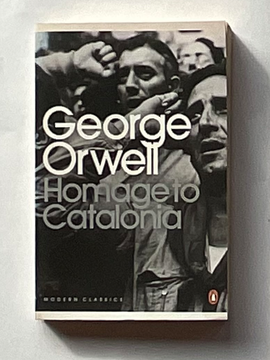
- On my return from Spain I thought of exposing the Soviet myth in a story that could be easily understood by almost anyone and which could be easily translated into other languages [about "Homage to Catalonia"]
- Very nearly all English left-wingers, from Labourites to Anarchists, have the outlook of people who neither want nor expect power
- The whole left-wing ideology, scientific and utopian, was evolved by people who had no immediate prospect of attaining power. It was, therefore, an extremist ideology, utterly contemptuous of kings, governments, laws, prisons, police forces, armies, flags, frontiers, patriotism, religion, conventional morality, and, in fact, the whole existing scheme of things. Until well within living memory the forces of the Left in all countries were fighting against a tyranny which appeared to be invincible, and it was easy to assume that if only that particular tyranny - capitalism - could be overthrown, Socialism would follow. Moreover, the Left had inherited from Liberalism certain distinctly questionable beliefs, such as the belief that the truth will prevail and persecution defeats itself, or that man is naturally good and is only corrupted by his environment. ..
- The experience of German occupation taught the European peoples something that the colonial peoples knew already, namely, that class antagonisms are not all-important and that there is such a thing as national interest. After Hitler it was difficult to maintain seriously that 'the enemy is in your own country' and that national independence is of no value. But though we all know this and act upon it when necessary, we still feel that to say it aloud would be a kind of treachery.
- .. the louder people yap about the proletariat, the more they despise its language
- They take their cookery from Paris and their opinions from Moscow
- As for the word ‘bourgeois’, it is used almost exclusively by people who are of bourgeois origin themselves
- Pacifists claim with even greater confidence that Britain is already a Fascist country and indistinguishable from Nazi Germany, although the very fact that they are allowed to write and agitate contradicts them.
- I don’t agree with pacifism, but I judge the sincerity of pacifists by the subjects they avoid
- Hitler's positive achievement appeals to the emptiness of these people, and, in the case of those with pacifist leanings, to their masochism
- .. Marxism, which was a German theory interpreted by Russians and unsuccessfully transplanted to England.
- All revolutions are failures, but they are not all the same failure.
The military angle:
- Constantly, as I walk down the street, I find myself looking up at the windows to see which of them would make good machine-gun nests. [25 July 1940 and a looming German invasion]
- .. the pilotless plane, flying bomb, or whatever its correct name may be, is an exceptionally unpleasant thing, because, unlike most other projectiles, it gives you time to think. What is your first reaction when you hear that droning, zooming noise? Inevitably, it is a hope that the noise won't stop. You want to hear the bomb pass safely overhead and die away into the distance before the engine cuts out. In other words, you are hoping that it will fall on somebody else. [cf. drones]
- V2 .. supplies another instance of the contrariness of human nature. People are complaining .. 'It wouldn't be so bad if you got at bit of warning' is the usual formula. There is even a tendency to talk nostalgically of the days of the V1. .. Some people are never satisfied. Personally, I am no lover of the V2, especially at this moment when the house still seems to be rocking from a recent explosion, but what depresses me about these things is the way they set people talking about the next war.
- [V2 rockets] Every time one goes off I hear gloomy references to 'next time', and the reflection: 'I suppose they'll be able to shoot them across the Atlantic by that time.' but if you ask who will be fighting whom when this universally expected war breaks out, you get no clear answer. It is just war in the abstract – the notion that human beings could ever behave sanely having apparently faded out of many people's memories.
- .. whereas the Germans shot off 8,000 doodlebugs, or something under 8,000 tons of high explosive, we dropped 100,000 tons of bombs on the bases, besides losing 450 aeroplanes and shooting off hundreds of thousands or millions of A.A. shells [anti-aircraft]. One can only make rough calculations at this date, but it looks as though the doodlebug may have a big future in forthcoming wars. [doodlebug = V1 and V2 rockets]
- For there is no such thing as neutrality in war; in practice one must help one side or the other
Clear language:
Personal Matters:
- Orwell's real name was Eric Blair. In a letter in 1932 he is discussing which pen name to choose, Kenneth Miles, George Orwell, or H. Lewis Allways.
- In 1936 he writes to a friend that he plans to marry, and that he expected never to be rich by writing: ".. it will always be hand to mouth as I don't see myself ever writing a best-seller". He did.
- In 1937 he was wounded in the Spanish Civil war. He was shot through the neck. He wrote to a friend: "I also can't sing, but people tell me this doesn't matter".
- In June 1940 a German invasion was looming. Orwell did not want to escape to Canada. He wrote in his war diary: "Better to die if necessary, and maybe even as propaganda one's death might achieve more than going abroad and living more or less unwanted on other people's charity. Not that I want to die; I have so much to live for, in spite of poor health and having no children."
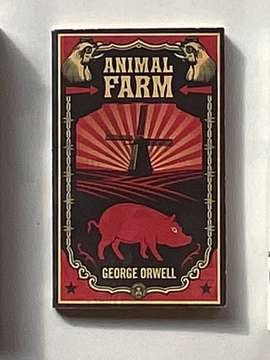
- "Animal Farm" sold in 250,000 copies in 1945, and later in 11 million copies worldwide
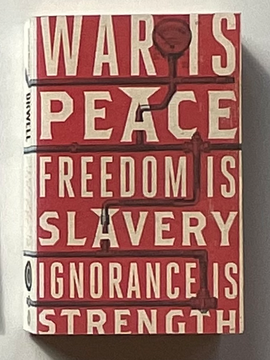
- In the autumn of 1948 Orwell was dying of tuberculosis. He wrote to his publisher Fredric Warburg that he had completed the work with the new book. Maybe it should be called "Nineteen Eighty-Four"? I find it quite touching that he expected that it could be sold in 10,000 copies: "I suppose one could be sure of 10,000 anyway". It sold in over 30 million copies worldwide.
What makes an author's work survive?
Let's take a look on what Orwell wrote about Dickens – because that is quite suitable for Orwell himself. George Orwell's works have survived, and he has become a national institution.
Orwell's latest books are the result of a tireless work with essays, reviews and letters. In my opinion "Homage to Catalonia" (1938) is his best book. Here also Animal Farm, 1945, and Nineteen Eighty-Four (1949).
Orwell about his three latest books:
- .. For example, that Spanish war book, which is about the best I have written.
- My book about the Spanish Civil War, Homage to Catalonia, is, of course, a frankly political book, .. If I had not been angry about that I should never have written the book.
- Animal Farm was the first book in which I tried, with full consciousness of what I was doing, to fuse political purpose and artistic purpose into one whole.
- [about Nineteen Eighty-Four, in a letter:] My recent novel is NOT intended as an attack on Socialism or on the British Labour Party (of which I am a supporter) but as a show-up of the perversions to which a centralized economy is liable and which have already been partly realized in Communism and Fascism. I do not believe that the kind of society I describe necessarily will arrive, but I believe .. that something resembling it could arrive. I believe also that totalitarian ideas have taken root in the minds of intellectuals everywhere, and I have tried to draw these ideas out to their logical consequences.
Please note that the selection of quotes is what suited me, and that you may prefer some other selection. I take responsibility in advance for typos and other mistakes. Text (in parenthesis) is Orwell's, text [in brackets] is mine.
Ebbe Munk
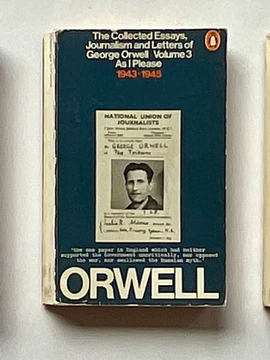
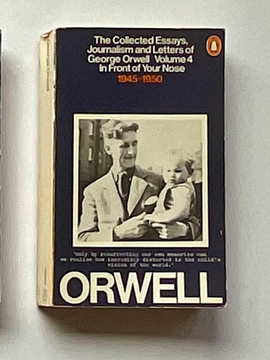
- "The Collected Essays, Journalism, and Letters of George Orwell", Volume 1-4, edited by Sonia Orwell and Ian Angus, Penguin, 1968
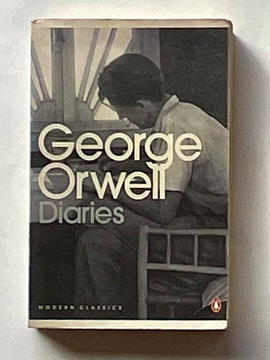
- George Orwell: "Diaries", Penguin 2010, edited by Peter Davison
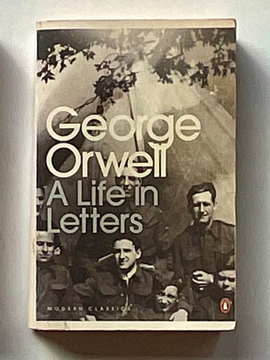
- George Orwell: "A Life in Letters", Penguin 2010, edited by Peter Davison
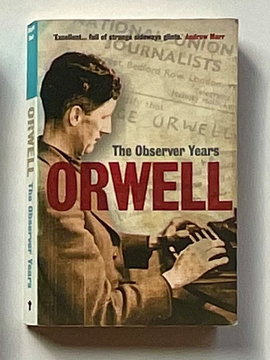
- George Orwell: "The Observer Years", Atlantic Books 2004
- George Orwell: "Essays", Penguin Classics, 1994, edited by Peter Davison (source for most of the essays)
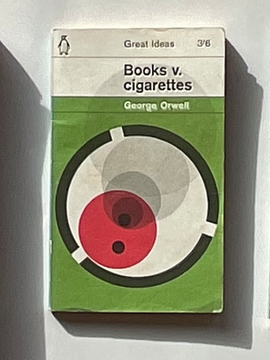
- George Orwell: "Books v. Cigarettes", Essays, Penguin 1984
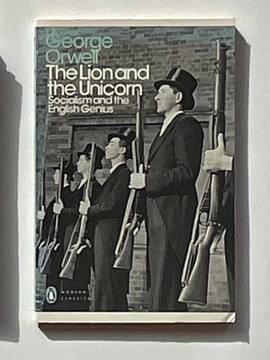
- George Orwell: "The Lion and the Unicorn", Essays, Penguin Classics, 1982
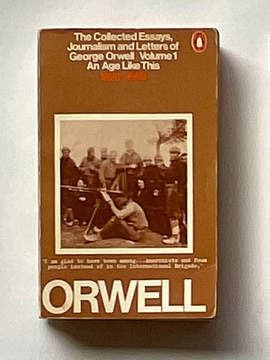
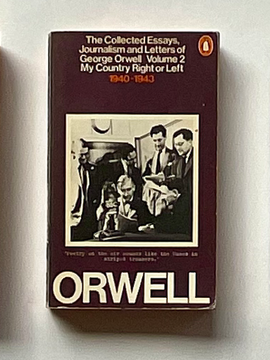
The Collected Essays, Journalism, and Letters of George Orwell, Volume 1-4, edited by Sonia Orwell and Ian Angus, Penguin, 1968. The cover photos show Orwell in Spain, at the BBC, as a journalist, and as a father.
"The Observer Years", 2004, "Diaries" and "A Life in Letters", the last ones edited by Peter Davison 2010
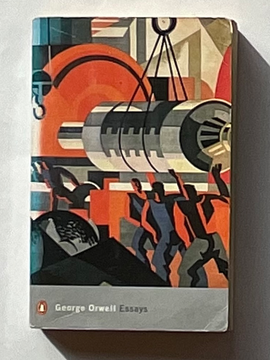
Three collections of essays: "Essays" (Penguin Classics 1994), "Books v. cigarettes", Penguin 1984, and "The Lion and the Unicorn", Penguin 1982
An extract from Bernard Crick's introduction to "Essays": "He saw the common reader as potentially the idealized 'common man' of Thomas Jefferson and Immanuel Kant .. a creature of common sense and decency, neither servile nor needing servants, who could do most things with his own hands and who wore any formal learning lightly." p. ix.
That common man could also have been George Orwell himself.
Sonia Orwell and Ian Angus' introduction to "Collected Essays, Journalism, and Letters of George Orwell, Volume 1":
.. No one could have written as much journalism as he did and kept it all on the same level, certainly not someone who was so often tired and unwell. He could make a hack review come alive sometimes by a single sentence or a joke, and Ian Angus and I have included many for the sake of one or two phrases which no one but Orwell could have written, .. p. 15
.. he never took a line other than the one he himself felt at the moment of writing. What he did as a journalist was argue out his ideas as he went along, through article after article in left-wing journal after left-wing journal, in little magazines which often paid badly, had few readers, but which he felt stood for something worthwhile, almost as if he was talking to the reader, examining his thoughts in conversation. .. it is typical of him that when the war was as good as won, his first reaction, in one of his last 'London Letters', was to admit and discuss the fact that much of his political analysis and his prophecies as to the outcome of the war had been based on a wrong assumption. p. 16
Only in "Animal Farm" and "Nineteen Eighty-Four" did Orwell set out deliberately to compose political ideas into the novel form and of his journalism from 1939 onwards discussed the ideas crystallized in these novels. For years he had been examining them in print in one context or another, arguing them out, as it were, with himself in public. It would be hard to find another journalist so prepared to contradict himself, who hammers away at an argument so as to turn it round form every angle before he felt it had been properly examined. p. 17